People, please be reminded that all of these images are Copywritten, and as such can not and should not be used and or published without our permission! Please refer to statement in the right side banner, if you please.
Anyone using any of the images that appear on FLICKR, may not be copied or used in various other pages with out obtaining our permission. To do so without such permission will result in those individuals having to reimburse us monetarily per each image. Many of these images are used outright by certain publishers, and my not be used by others without permission from the publishers.
Perhaps my most memorable image that has been transformed from grey and cloudy surroundings into a multi-colored creation is this diatom - genus Entomoneis - titled Cretaceous Raptor.This image required a whole week of developing the color pattern and color gradations that resulted in the final product. It was quite exhausting in the creation, but a rewarding result.
The 5.5m carcass - which needed 16 people to bring it ashore - will be buried in sand before it is reconstructed for display.
Video: Snorkeller Finds Monster 'Serpent'
A marine biologist has made
the discovery of a lifetime - the five-metre-long [18 ft. approx.] silvery carcass of
the creature belived to be the origin of sea serpent legends.
Jasmine Santana of the Catalina Island Marine Institute (CIMI) was
snorkelling with colleagues in Toyon Bay, southern California when she
spotted something shimmering in the water.
She dragged the eel-like beast by the tail for more than 20m, others waded in to the sea and helped her bring it to shore.
After taking a closer look she discovered it was an oarfish, which can grow up to 15m.
"Jasmine Santana was shocked to see (a) half-dollar sized eye staring
at her from the sandy bottom," the institute said in a statement.
"Her first reaction was to approach with caution, until she realised that it was dead."
Oarfish are deep-water pelagic fish and the longest bony fish in the world, according to CIMI.
Because oarfish dive more than 3,000 feet (914 metres) deep, sightings
of the creatures are rare and they are largely unstudied.
"We've never seen a fish this big," said Mark Waddington, senior captain of the Tole Mour, CIMI's sail training ship.
"The last oarfish we saw was three feet long."
Tissue samples and video footage were sent to be studied by biologists at the University of California in Santa Barbara.
It will be buried in the sand until it decomposes and then its skeleton will be reconstructed for display.
The fish apparently died of natural causes.
As you can see, an Oyster Festival can be the perfect platform for a variety of subjects involving the Indian River Lagoon Speakers Series including a presentation by Dr. Hargraves regarding 'Red Tides', utilizing about ten of our colorised images to illustrate his discussion at the Ft. Pierce Yacht Club waterfront.
At the Smithsonian Marine Station in Fort Pierce, FL, a community
open house was recently held which in part featured over a dozen
colorized scanning electron micrographs originally taken by Dr. Paul
Hargraves of the Harbor Branch Oceanographic Institute. The open house
was attended by nearly 600 persons, and the dialog and photos stimulated
much interest about the microscopic life in Florida coastal waters.
Dr. Hargraves is in the foreground describing various points to visitors at the open house. Some of the colorized SEM images can be seen in the background.
I am happy to announce that a new colorization that I recently completed has been selected as a cover for Applied and Environmental Microbiology. The image illustrates the subject of an accepted paper on the freshwater biofilm written by Sophia I. Passy, PhD and her co-writer, Chad A. Larson. "The rates of species accumulation and taxonomic diversification during phototrophic biofilm development are co-controlled
by nutrient supply and current velocity."
The
scanning electron micrograph of the diatom Achnanthidium sp. from Blue
Cypress Lake, FL, was provided by Dr. Paul Hargraves.
I recently was asked to colorize some new images for a scientist out west, and in the process, I recolored the original Skeltonema image into this new one. I am surprised that I never thought of this colorization scheme, but am impressed with the detail that I was able to obtain with this new color pallet.
This past year has seen a variety of events that promote the colorisations, and also continued work of Dr. Hargraves.
RedBubble provided us with more popularity than ever of the Diatom Mandalas and Diatom/Dinoflagellate images in various challenges and features, and also favored us with several purchases of individual prints.
"Great news--your fabulous image was
selected for the journal cover! Congratulations--Ecology Letters is by
far the #1 journal in Ecology and this is a great recognition for us and
for diatoms, which do not get the
spotlight very often!"
On
Friday, November 9th, at the Smithsonian Marine Station at Ft. Pierce,
Florida, Dr. Paul E Hargraves gave 'A tripartite presentation on the
lifestyles and diversity of microalgae in the Indian River lagoon
system; whether or not harmful algal blooms are a clear and present
danger [or not], and whether characterising the IRL as 'the most diverse
estuary in North America' is a bogus claim, or a reality'.
In all, this has been an exciting and productive year. New images are planned for the coming early spring, and perhaps a new exhibition. More about that later. Thank you for your continued interest.
On Friday, November 9th, at the Smithsonian Marine Station at Ft. Pierce, Florida, Dr. Paul E Hargraves gave 'A tripartite presentation on the lifestyles and diversity of microalgae in the Indian River lagoon system; whether or not harmful algal blooms are a clear and present danger [or not], and whether characterising the IRL as 'the most diverse estuary in North America' is a bogus claim, or a reality'.
Dr. Hargraves is Emeritus Professor of Oceanography, Univ. of Rhode Island, Affiliate Professor, Harbor Branch Oceanographic inst., and FAU Research Associate, Smithsonian Marine Laboratory.
Well, I had a pretty exciting day yesterday. My colleague,
Dr. Paul E Hargraves, sent me an email telling him/me that my/our colorised
image file of diatoms/dinoflagellates has been added to the website called the "Plankton Art" section of the ISSHA website [International Society for the Study of Harmful Algae]. Fay Darling's Plankton Art.
Karin Rengefors, Secretary of ISSA, was kind enough to contact Paul, and
tell us about the inclusion. "The overall mandate of the Society is to
promote and foster research and
training programs on harmful algae, and to co-sponsor meetings on
this topic at the national, regional, and international level." [if you
click on 'Fay Darling's Plankton Art' then click again on the blue bar,
it will take you to our Flickr page to see more images].
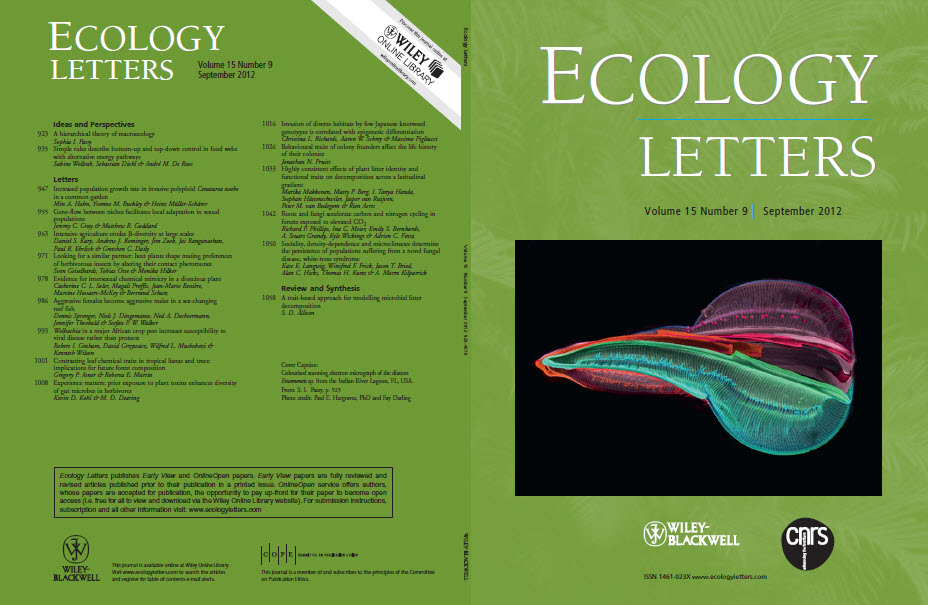
I am thrilled to post an image of my two hard copies of Ecology Letters recently sent to me by my contact: Ms. Sophia I. Passy, PhD , Associate Professor, UTA.
Sophia was instrumental in searching for, and ultimately brokering the cover image to Ecology Letters. The image was chosen from a large group of submissions, so the competition was sharp. Pretty exciting happening to actually have them on hand now.
I am very happy and excited to announce that one of our diatom images has been selected to be on the new cover of Ecology Letters, September 2012. The cover image was selected from a group of other candidates. It is a different colorway version of my Cretaceous Raptor image in blues, but is a really nice adaptation of colors well suited to the journal cover and format.
I have to thank Sophia Passy, PhD, Professor of Biology, from the University of Texas, Arlington, who initiated an inquiry to Dr. Hargraves about submitting an image for consideration to become a cover for the latest ELcover. After some correspondence, and my submission of the image, on July 9th, Dr. Passy sent me the following:"Great news--your fabulous image was selected for the journal cover! Congratulations-Ecology Letters is by far the #1 journal in Ecology and this is a great
recognition for us and for diatoms, which do not get the
spotlight very often!'
After a multi-decadal career at the Graduate School of Oceanography of the University of Rhode Island, Dr. Paul Hargraves is now an Affiliated Research Professor in Harbor Branch's Center for Marine Ecosystem Health.
His research interests focus on the biodiversity, systematics,
ultrastructure, and life cycles of microscopic life in aquatic
environments, and his >100 publications include research on fresh
water, coastal, and oceanic environments from the North Atlantic to the Antarctic, from the Peruvian Amazon to Australia's Great Barrier Reef, from the Indian River Lagoon to 50-million year-old fossils.
During his career, Dr. Hargraves has received research funding totaling several million dollars from the National Science Foundation, the Environmental Protection Agency, National Oceanic & Atmospheric Agency, the National Sea Grant program, and several private organizations. He has been a visiting professor at the National University of Costa Rica
and at the University of Salzburg, Austria, served as Associate Dean
of the Graduate School of Oceanography, and held adjunct positions at
several other universities. His former students, including 12 Ph.D.
and 20 M.S. recipients, have gone on to successful careers in academia,
industry, and government, and he has served on the thesis committees
of over 50 additional graduate students. He attributes his early and
lifelong interest in the marine environment to many summers spent
digging in the mud on Cape Cod.
"Great news--your fabulous image was
selected for the journal cover! Congratulations--Ecology Letters is by
far the #1 journal in Ecology and this is a great recognition for us and
for diatoms, which do not get the
spotlight very often!" Certainly exciting news. I can't wait to see it in publication. I will post the cover when I receive a copy
Our Blue Ribbon image made a sale this week at Red Bubble. There has been a consistent interest in all of the images, and nice to know that they are so appreciated.
I just received notice that one of my colorized images was sold at RedBubble. It is an interesting shape that I named Midnight Triangle [Trigonium altmans]. Not a big monetary sale, but one very nice image that was selected, nevertheless. Thank you very much to the person who bought the print. This always supports the cause.
My newest creation is this Mauve Scallop kaleidoscope design that has just received two features in two different groups at RedBubble.It was derived from a Digital colorization of an electron microscopic image of Ebridian done in two different color ways - for this one it originated from the one called Torture Magenta.---->
A favorite combination titled 'Miro Mira' was selected as a feature in 'Art For Sale' at RedBubble yesterday.
It is pictured in the bottom row, second from the right. Interesting to see all the different shapes and how they all blend together in this stunning group. So happy to be included.
The images all appear on the group Facebook Fan Page too, for added exposure.